

 Suche
Suche
 Mein Konto
Pyoderma gangrenosum
Pyoderma gangrenosum
overview
Advanced pyoderma gangrenosum
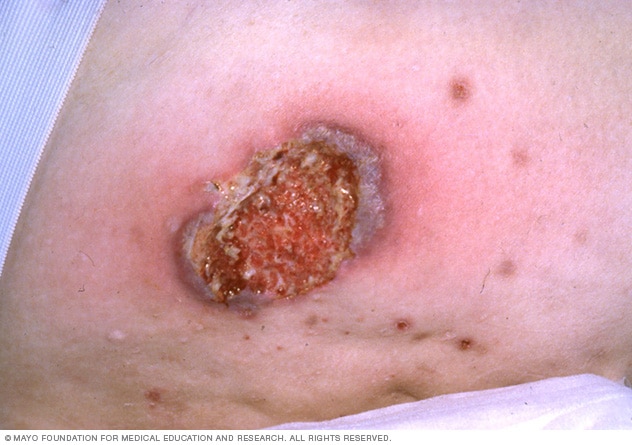
Advanced pyoderma gangrenosum
Pyoderma gangrenosum can cause painful, open sores (ulcers) that have bluish, overhanging edges.
Pyoderma gangrenosum (Pie-o-DUR-muh gang-ruh-NO-sum) is a rare condition in which large, painful sores (ulcers) develop on your skin, most often on your legs.
The exact causes of pyoderma gangrenosum are unknown, but it appears to be an immune system disorder. People with certain underlying medical conditions, such as inflammatory bowel disease or arthritis, are at higher risk of pyoderma gangrenosum.
Pyoderma gangrenosum ulcers can develop quickly. They usually disappear with treatment, but scarring and recurrences are common.
Symptoms
Pyoderma gangrenosum usually starts with a small, red bump on your skin that may resemble a spider bite. Within a few days, this bump can develop into a large, painful open sore.
The ulcer usually appears on your legs but can develop anywhere on the body. Sometimes it appears near surgical sites. If you have multiple ulcers, they may grow and merge into one larger ulcer.
When to go to the doctor?
Talk to your doctor if you develop a painful, rapidly growing skin sore.
Causes
The exact cause of pyoderma gangrenosum is unknown. The condition is not contagious or contagious. It is often associated with autoimmune diseases such as ulcerative colitis, Crohn's disease and arthritis. And it may have a genetic component.
If you have pyoderma gangrenosum, new skin trauma, such as a cut or puncture wound, can trigger new ulcers.
Risk factors
Certain factors may increase your risk of pyoderma gangrenosum, including:
- Ihr Alter und Geschlecht. Der Zustand kann jeden in jedem Alter betreffen, obwohl er häufiger zwischen 20 und 50 Jahren auftritt.
- Entzündliche Darmerkrankung haben. Menschen mit einer Erkrankung des Verdauungstrakts wie Colitis ulcerosa oder Morbus Crohn haben ein erhöhtes Risiko für Pyoderma gangraenosum.
- Arthrose haben. Menschen mit rheumatoider Arthritis haben ein erhöhtes Risiko für Pyoderma gangraenosum.
- Eine Blutkrankheit haben. Menschen mit akuter myeloischer Leukämie, Myelodysplasie oder einer myeloproliferativen Erkrankung haben ein erhöhtes Risiko für Pyoderma gangraenosum.
Complications
Possible complications of pyoderma gangrenosum include infection, scarring, uncontrolled pain, depression and loss of mobility.
prevention
You cannot completely prevent pyoderma gangrenosum. If you have the condition, try not to hurt your skin. Injury or trauma to your skin, including from surgery, can cause new ulcers to form. It can also help control any underlying medical conditions that may be causing the ulcers.
Treatment of pyoderma gangrenosum
Sources:
- Fragen Sie MayoExpert. Pyoderma gangraenosum. Rochester, Minnesota: Mayo Foundation for Medical Education and Research; 2018.
- Fragen Sie MayoExpert. Hautgeschwüre. Rochester, Minnesota: Mayo Foundation for Medical Education and Research; 2017.
- DeFilipps EM, et al. Die Genetik von Pyoderma gangraenosum und Implikationen für die Behandlung: Eine systematische Überprüfung. Britisches Journal für Dermatologie. 2015;172:1487.
- Okhovat JP, et al. JAMA Dermatology Patientenseite: Pyoderma gangraenosum. JAMA Dermatologie. 2014;150:1032.
- Stair-Buchmann ME, et al. Pyoderma gangraenosum: Eine schwierige Diagnose, die am besten in einem Behandlungszentrum für Verbrennungen behandelt wird. Journal of Burn Care Research. 2015;36:3190.
- Cabalag MS, et al. Stationäre Behandlung von Pyoderma gangraenosum: Behandlungen, Ergebnisse und klinische Auswirkungen. Annalen der Plastischen Chirurgie. 2015;74:354.
- Bolognia JL, et al., Hrsg. Neutrophile Dermatosen. In: Dermatologie. 4. Aufl. Philadelphia, Pennsylvania: Saunders Elsevier; 2018. https://www.clinicalkey.com. Abgerufen am 8. Oktober 2018.
- Tolkachjov SN, et al. Postoperatives Pyoderma gangraenosum (PG): Die 20-jährige Erfahrung der Mayo Clinic von 1994 bis 2014. Journal of the American Academy of Dermatology. 2015;73:615.
- Afifi L, et al. Diagnose und Behandlung von Pyoderma gangraenosum periostomal: Eine systematische Überprüfung. Zeitschrift der American Academy of Dermatology. 2018;78:1195.
- Dabade TS, et al. Diagnostik und Therapie der neutrophilen Dermatosen (Pyoderma gangraenosum, Sweet-Syndrom). Dermatologische Therapie. 2011;24:273.
- Gibson LE (Gutachten). Mayo Clinic, Rochester, Minnesota, 29. Okt. 2018.