

 Suche
Suche
 Mein Konto
Retrograde ejaculation
Retrograde ejaculation
overview
Retrograde ejaculation occurs when sperm enters the bladder instead of exiting through the penis during orgasm. Although you still reach sexual climax, you may ejaculate very little or no semen. This is sometimes called a dry orgasm.
Retrograde ejaculation is not harmful, but it can cause male infertility. Treatment for retrograde ejaculation is generally only needed to restore fertility.
Symptoms
Retrograde ejaculation doesn't affect your ability to get an erection or have an orgasm - but when you climax, the semen goes into your bladder instead of coming out of your penis. Signs and symptoms of retrograde ejaculation include:
- Orgasmen, bei denen Sie sehr wenig oder kein Sperma aus Ihrem Penis ejakulieren (trockene Orgasmen)
- Urin, der nach dem Orgasmus trüb ist, weil er Sperma enthält
- Unfähigkeit, eine Frau schwanger zu bekommen (männliche Unfruchtbarkeit)
When to go to the doctor?
Retrograde ejaculation is not harmful and only requires treatment if you are trying to conceive a child. However, if you are experiencing dry orgasms, see your doctor to make sure your condition is not caused by an underlying problem that requires attention.
If you and your partner have had regular unprotected sex for a year or more and have not conceived, see your doctor. Retrograde ejaculation could be the cause of your problem if you ejaculate very little or no semen.
Causes
Retrograde ejaculation
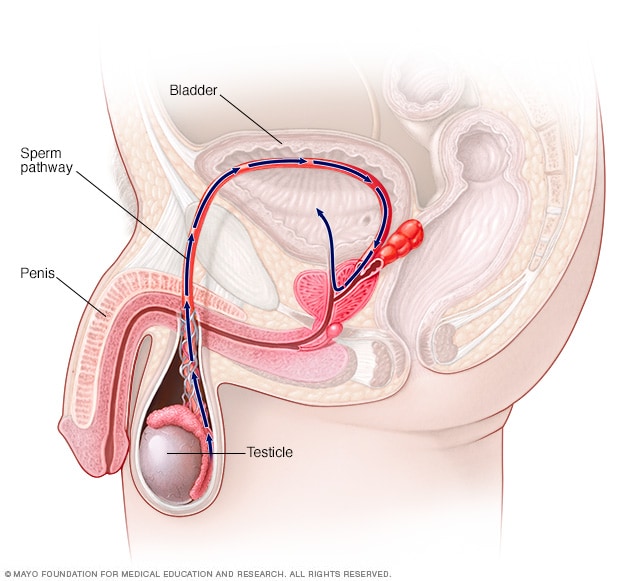
Retrograde ejaculation
During retrograde ejaculation, semen travels into the bladder instead of leaving the body through the penis.
During a male orgasm, a tube called the vas deferens carries sperm to the prostate, where they mix with other fluids to produce liquid semen (ejaculate). The muscle at the opening of the bladder (bladder neck muscle) tightens to prevent ejaculate from entering the bladder as it passes from the prostate into the tube inside the penis (urethra). This is the same muscle that holds urine in your bladder until you urinate.
During retrograde ejaculation, the bladder neck muscle does not tense properly. As a result, sperm can enter the bladder instead of being expelled from your body through the penis.
Several conditions can cause problems with the muscle that closes the bladder during ejaculation. These include:
- Operationen wie Blasenhalsoperationen, retroperitoneale Lymphknotendissektionen bei Hodenkrebs oder Prostataoperationen
- Nebenwirkung bestimmter Medikamente zur Behandlung von Bluthochdruck, Prostatavergrößerung und Depressionen
- Nervenschäden, die durch eine Erkrankung wie Diabetes, Multiple Sklerose, Parkinson oder eine Rückenmarksverletzung verursacht werden
A dry orgasm is the primary sign of retrograde ejaculation. But dry orgasm – the ejaculation of little or no semen – can also be caused by other conditions, including:
- Operative Entfernung der Prostata (Prostatektomie)
- Operative Entfernung der Blase (Zystektomie)
- Strahlentherapie zur Behandlung von Krebs im Beckenbereich
Risk factors
You are at increased risk of retrograde ejaculation if:
- Sie haben Diabetes oder Multiple Sklerose
- Sie hatten eine Prostata- oder Blasenoperation
- Sie nehmen bestimmte Medikamente gegen Bluthochdruck oder eine Stimmungsstörung ein
- Sie hatten eine Rückenmarksverletzung
Complications
Retrograde ejaculation is not harmful. However, possible complications include:
- Unfähigkeit, eine Frau schwanger zu bekommen (männliche Unfruchtbarkeit)
- Weniger angenehmer Orgasmus aufgrund von Sorgen über fehlendes Ejakulat
prevention
If you are taking medications or have health problems that put you at risk of retrograde ejaculation, ask your doctor what you can do to reduce your risk.
If you have surgery that could affect the bladder neck muscle, such as: B. prostate or bladder surgery, ask about the risk of retrograde ejaculation. If you plan to have children in the future, talk to your doctor about sperm preservation options before surgery.
Sources:
- Ferri FF. Ejakulations- und Orgasmusstörungen. In: Ferri’s Clinical Advisor 2022. Elsevier; 2022. https://www.clinicalkey.com. Abgerufen am 28. Oktober 2021.
- Mehta A. et al. Management des trockenen Ejakulats: Eine systematische Überprüfung von Aspermie und retrograder Ejakulation. Fruchtbarkeit und Sterilität. 2015;104:107.
- Althof HE, et al. Zeitgenössisches Management von Störungen des männlichen Orgasmus und der Ejakulation. Urologie. 2016;93:9.
- Was ist Unfruchtbarkeit? Lösung: Die National Infertility Association. http://www.resolve.org/about-infertility/what-is-infertility/frequently-asked-questions-about-infertility.html. Abgerufen am 15. September 2016.
- Ohl DA, et al. Anejakulation und retrograde Ejakulation. Urologische Kliniken von Nordamerika. 2008;35:211.
- Partin AW, et al., Hrsg. Störungen des männlichen Orgasmus und der Ejakulation. In: Campbell-Walsh-Wein-Urologie. 12. Aufl. Elsevier; 2021. https://www.clinicalkey.com. Abgerufen am 28. Oktober 2021.
- Samplaski MK, et al. Nebenwirkungen gängiger Medikamente auf die männliche Fruchtbarkeit. Nature Reviews Urologie. 2015;12:401.
- Jefferys A, et al. Das Management der retrograden Ejakulation: Eine systematische Überprüfung und Aktualisierung. Fruchtbarkeit und Sterilität. 2012;97:306.