

 Suche
Suche
 Mein Konto
Rosola
Rosola
overview
Roseola is a common infection that usually affects children as young as 2 years old. It is caused by a virus that spreads from person to person. It can cause a high fever followed by a rash that doesn't itch or hurt. About a quarter of people with roseola get a rash.
Roseola, also known as sixth disease, is usually not serious and goes away on its own in about a week. Treatment for roseola includes cool wipes and medication to reduce fever.
Symptoms
Rosola
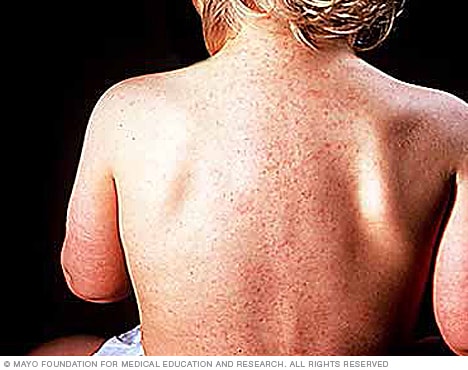
Rosola
Roseola is a childhood disease caused by two strains of the herpes virus. Common signs of roseola include fever and a rash on the trunk and neck.
If your child is exposed to someone with roseola and becomes infected with the virus, it will likely take 1 to 2 weeks for signs and symptoms of infection to appear. Or they don't appear at all. It is possible to become infected with roseola but not show any signs of it.
Roseola symptoms can include:
- Fieber. Roseola beginnt oft mit hohem Fieber – oft höher als 103 F (39,4 C). Es beginnt plötzlich und dauert 3 bis 5 Tage. Einige Kinder können auch Halsschmerzen, eine laufende Nase oder Husten zusammen mit oder vor dem Fieber haben. Ihr Kind kann auch geschwollene Lymphknoten im Nacken entwickeln.
-
rash.After the fever has subsided, a rash often appears. A roseola rash consists of many small spots or spots. These spots tend to be flat.
The rash often starts on the chest, back, and stomach and then spreads to the neck and arms. It could reach the legs and face. The rash is unlikely to be itchy or painful. It can last hours or days. The rash may initially appear without fever.
Other signs and symptoms of roseola may include:
- Reizbarkeit
- Leichter Durchfall
- Verminderter Appetit
- Geschwollene Augenlider
When to go to the doctor?
Seek medical attention immediately
Your child may have a seizure (febrile seizure) if the fever becomes high or rises quickly. If your child has an unexplained seizure, seek medical attention immediately.
Call your child's doctor
Call your child's doctor if:
- Ihr Kind hat hohes Fieber, über 103 F (39,4 C)
- Der Ausschlag bessert sich nach drei Tagen nicht und das Fieber kehrt zurück
Call your doctor
Contact your doctor if anyone in the household has a problem with their immune system and comes into contact with someone who has roseola. You may need to be monitored for a possible infection, which could be more serious than in someone with a strong immune system.
Causes
Roseola is caused by a virus, usually human herpesvirus 6 or sometimes human herpesvirus 7. It is spread through contact with the saliva of an infected person, such as: B. when sharing a cup, or through the air, e.g. B. when a person with roseola coughs or sneezes. It can take about 9 to 10 days for symptoms to develop after contact with an infected person.
Roseola is no longer contagious after the fever has disappeared for 24 hours.
Unlike chickenpox and other childhood viral diseases that spread quickly, roseola rarely results in a community-wide outbreak. The infection occurs most often in spring and autumn.
Risk factors
The risk of roseola is highest in older infants. It is most common between 6 and 15 months. Older infants are at greatest risk of getting roseola because they have not yet had time to develop their own antibodies to many viruses. Newborns are protected by antibodies they receive from their mothers during pregnancy. But this immunity decreases over time.
Complications
Roseola is usually a mild disease, but it can cause complications.
Seizures in children
Occasionally, a child with roseola will have a seizure (febrile seizure) caused by a sudden fever. In this case, your child may briefly lose consciousness, fall, and have twitching arms and legs for several seconds to minutes.
If your child has a seizure, seek emergency care. Although frightening, febrile seizures in otherwise healthy children tend to be short-lived and are rarely harmful.
Concerns for people with weak immune systems
Roseola is of greater concern in people with weak immune systems. For example, you might have a weak immune system if you recently had a bone marrow transplant. People with a weak immune system have less resistance to viruses. They tend to develop more severe roseola or complications such as pneumonia or encephalitis. Encephalitis is a potentially life-threatening inflammation of the brain.
prevention
There is no vaccine to prevent roseola. You can protect others by keeping a child with a fever home until the fever has gone for 24 hours. Then, even if a roseola rash is present, the disease is not contagious.
Most people have antibodies to roseola by school age, which makes them immune to a second infection. However, if a household member contracts the virus, make sure all family members wash their hands frequently to prevent the virus from spreading to people who are not immune.
Sources:
- AAP-Ausschuss für Infektionskrankheiten. Empfehlungen zur Prävention und Kontrolle der Influenza bei Kindern, 2017-2018. Pädiatrie. 2017; doi:10.1542/peds.2017-2550.
- Sullivan JE, et al. Klinischer Bericht – Fieber und Anwendung von Antipyretika bei Kindern. Pädiatrie. 2011; doi:10.1542/peds.2010-3852. Juli 2016 bestätigt.
- 314 Kennzeichnung von Arzneimittelzubereitungen, die Salicylate enthalten. Elektronischer Code of Federal Regulations. https://www.ecfr.gov/cgi-bin/text-idx?SID=76be002fc0488562bf61609b21a6b11e&mc=true&node=se21.4.201_1314&rgn=div8. Abgerufen am 22. Februar 2018.
- Renaud DL (Gutachten). Mayo-Klinik; 2018.
- Marcdante KJ, et al., Hrsg. Infektionen, die durch Fieber und Hautausschlag gekennzeichnet sind. In: Nelson Essentials of Pediatrics. 9. Aufl. Elsevier; 2023. https://www.clinicalkey.com. Abgerufen am 20. April 2022.
- Schmitt BD. Hautausschlag oder Rötung, weit verbreitet. In: Pädiatrische Telefonprotokolle: Office-Version. 17. Aufl. Amerikanische Akademie für Pädiatrie; 2021.
- Roseola infantum. Merck Manual Professional-Version. https://www.merckmanuals.com/professional/pediatrics/miscellaneous-viral-infections-in-infants-and-children/roseola-infantum. Abgerufen am 20. April 2022.
- Schmitt BD. Anfall mit Fieber. In: Pädiatrische Telefonprotokolle: Office-Version. 17. Aufl. Amerikanische Akademie für Pädiatrie; 2021.
- Roseola infantum. Amerikanische Akademie für Pädiatrie. https://www.healthychildren.org/English/health-issues/conditions/skin/Pages/Roseola-Infantum.aspx. Abgerufen am 20. April 2022.
- Tosh PK (Expertenmeinung). Mayo-Klinik. 21. April 2022.
- Tremblay C. et al. Roseola infantum (Exanthem subitum). https://www.uptodate.com/contents/search. Abgerufen am 20. April 2022.
- Hay WW Jr., et al., Hrsg. Infektionen: Virale & Rickettsien. In: Aktuelle Diagnose & Behandlung: Pädiatrie. 25. Aufl. McGraw-Hügel; 2020. https://accessmedicine.mhmedical.com. Abgerufen am 20. April 2022.