

 Suche
Suche
 Mein Konto
Thyroid nodules
Thyroid nodules
overview
thyroid
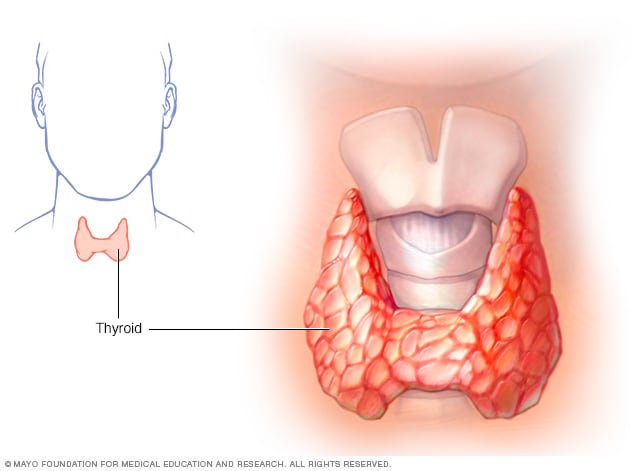
thyroid
Your thyroid is located at the base of your neck, just below the Adam's apple.
Thyroid nodules are solid or fluid-filled lumps that form in your thyroid, a small gland located at the base of your neck, just above your breastbone.
Most thyroid nodules are not serious and do not cause any symptoms. Only a small percentage of thyroid nodules are cancerous.
You often don't know you have a thyroid nodule until your doctor discovers it during a routine medical exam. Or your doctor may discover it during a scan done for another health reason. However, some thyroid nodules may become large enough to be visible or make it difficult to swallow or breathe.
Treatment options depend on the type of thyroid nodule you have.
Symptoms
Most thyroid nodules do not cause any signs or symptoms. But occasionally some nodules become so large that they:
- Gefühlt werden
- Gesehen werden, oft als Schwellung an der Basis Ihres Halses
- Drücken Sie auf Ihre Luftröhre oder Speiseröhre, was Kurzatmigkeit oder Schluckbeschwerden verursacht
In some cases, thyroid nodules produce extra thyroxine, a hormone secreted by your thyroid. The excess thyroxine can cause symptoms of overproduction of thyroid hormones (hyperthyroidism), such as:
- Unerklärlicher Gewichtsverlust
- Erhöhtes Schwitzen
- Tremor
- Nervosität
- Schneller oder unregelmäßiger Herzschlag
Only a few thyroid nodules are cancerous. But determining which nodules are cancerous cannot be done by evaluating your symptoms alone. Most cancerous thyroid nodules grow slowly and may be small when your doctor discovers them. Aggressive thyroid carcinomas are rare, with nodules that can be large, firm, fixed, and rapidly growing.
When to go to the doctor?
Although most thyroid nodules are noncancerous and do not cause problems, ask your doctor to check for any unusual swelling in your throat, especially if you have difficulty breathing or swallowing. It is important to evaluate the possibility of cancer.
See a doctor if you develop signs and symptoms of hyperthyroidism, such as:
- Plötzlicher Gewichtsverlust, obwohl Ihr Appetit normal ist oder zugenommen hat
- Ein pochendes Herz
- Schlafstörungen
- Muskelschwäche
- Nervosität oder Reizbarkeit
Also see your doctor if you have signs and symptoms that may indicate that your thyroid is not producing enough thyroid hormone (hypothyroidism), including:
- Frieren
- Sich leichter müde fühlen
- Trockene Haut
- Speicherprobleme
- Depression
- Verstopfung
Causes
Thyroid nodules
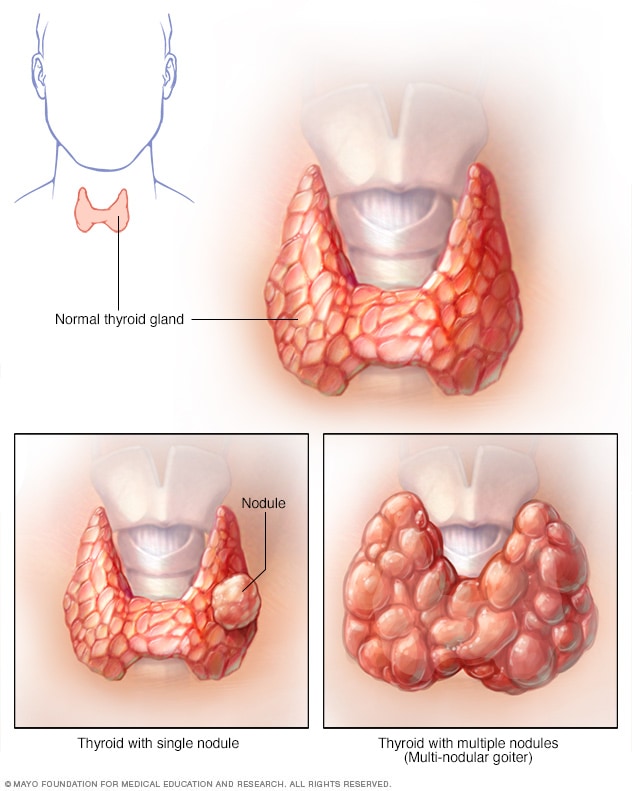
Thyroid nodules
An enlargement of the thyroid can expand the gland far beyond its typical size and cause a noticeable bulge in the neck. This can be caused by single or multiple nodules (lumps) in the thyroid or by an autoimmune process.
Several conditions can cause nodules to develop in your thyroid, including:
-
Overgrowth of normal thyroid tissue.An overgrowth of normal thyroid tissue is sometimes called a thyroid adenoma. It is unclear why this occurs, but it is not cancerous and is not considered serious unless it causes bothersome symptoms due to its size.
Some thyroid adenomas lead to hyperthyroidism.
- Schilddrüsenzyste. Flüssigkeitsgefüllte Hohlräume (Zysten) in der Schilddrüse resultieren am häufigsten aus degenerierenden Schilddrüsenadenomen. Häufig werden in Schilddrüsenzysten feste Bestandteile mit Flüssigkeit vermischt. Zysten sind normalerweise nicht krebsartig, enthalten aber gelegentlich krebsartige feste Bestandteile.
- Chronische Entzündung der Schilddrüse. Die Hashimoto-Krankheit, eine Schilddrüsenerkrankung, kann eine Schilddrüsenentzündung verursachen und zu vergrößerten Knötchen führen. Dies ist oft mit Hypothyreose verbunden.
- Multinodulärer Kropf. Als Kropf bezeichnet man jede Vergrößerung der Schilddrüse, die durch Jodmangel oder eine Schilddrüsenerkrankung verursacht werden kann. Ein multinodulärer Kropf enthält mehrere unterschiedliche Knötchen innerhalb des Kropfes, aber seine Ursache ist weniger klar.
-
Thyroid cancer.The chances of a lump being cancerous are slim. However, a lump that is large, hard, or causes pain or discomfort is more worrisome. You will probably want to have it checked by your doctor.
Certain factors increase your risk of thyroid cancer, such as: B. a family history of thyroid or other endocrine cancers and a history of radiation exposure from medical therapy or from nuclear fallout.
- Jodmangel. Ein Mangel an Jod in Ihrer Ernährung kann manchmal dazu führen, dass Ihre Schilddrüse Schilddrüsenknoten entwickelt. Aber Jodmangel ist in den Vereinigten Staaten ungewöhnlich, wo Jod routinemäßig Speisesalz und anderen Lebensmitteln zugesetzt wird.
Complications
Complications associated with some thyroid nodules include:
- Probleme beim Schlucken oder Atmen. Große Knötchen oder ein multinodulärer Kropf können das Schlucken oder Atmen beeinträchtigen.
-
Hyperthyroidism.Problems can occur when a nodule or goiter produces thyroid hormone, resulting in an excess amount of the hormone in the body. Hyperthyroidism can cause weight loss, muscle weakness, heat intolerance, and anxiety or irritability.
Possible complications of hyperthyroidism include an irregular heartbeat, weak bones, and thyrotoxic crisis, a rare but potentially life-threatening increase in signs and symptoms that requires immediate medical attention.
- Probleme im Zusammenhang mit Schilddrüsenknotenoperationen. Wenn Ihr Arzt eine Operation zur Entfernung eines Knotens empfiehlt, müssen Sie möglicherweise für den Rest Ihres Lebens eine Schilddrüsenhormon-Ersatztherapie einnehmen.
Sources:
- Fisher SB, et al. Der zufällige Schilddrüsenknoten. CA: Ein Krebsjournal für Kliniker. 2018; doi:10.3322/caac.21447.
- Schilddrüsenknoten. Hormongesundheitsnetzwerk. https://www.hormone.org/diseases-and-conditions/thyroid-nodules. Abgerufen am 31. Oktober 2019.
- Schilddrüsenknoten. American Thyroid Association. http://www.thyroid.org/thyroid-nodules/. Abgerufen am 31. Oktober 2019.
- Hyperthyreose. American Thyroid Association. http://www.thyroid.org/hyperthyroidism/. Abgerufen am 31. Oktober 2019.
- Ross DS. Überblick über die Bildung von Schilddrüsenknoten. https://www.uptodate.com/contents/search. Abgerufen am 31. Oktober 2019.
- Goldman L. et al., Hrsg. Schilddrüse. In: Goldman-Cecil Medicine. 26. Aufl. Elsevier; 2020. https://www.clinicalkey.com. Abgerufen am 31. Oktober 2019.
- Ferri FF. Schilddrüsenknoten. In: Ferri’s Clinical Advisor 2020. Elsevier; 2020. https://www.clinicalkey.com. Abgerufen am 31. Oktober 2019.
- Ross DS. Diagnostik und Behandlung von Schilddrüsenknoten. https://www.uptodate.com/contents/search. Abgerufen am 31. Oktober 2019.
- Hoang JK, et al. Verständnis der Risiken und Schäden der Behandlung zufälliger Schilddrüsenknoten: Eine Überprüfung. JAMA HNO-Heilkunde — Kopf- und Halschirurgie. 2017; doi:10.1001/jamaoto.2017.0003.
- Goldblum JR, et al., Hrsg. Schilddrüse. In: Rosai und Ackermans chirurgische Pathologie. 11. Aufl. Elselvier; 2018. https://www.clinicalkey.com. Abgerufen am 4. November 2019.
- Kellermann RD, et al. Schilddrüsenkrebs. In: Conn’s Current Therapy 2019. Elsevier; 2019. https://www.clinicalkey.com. Abgerufen am 4. November 2019.
- Perri F, et al. Schilddrüsenkrebs-Management: Vom verdächtigen Knoten zur zielgerichteten Therapie. Anti-Krebs-Medikamente. 2018; doi:10.1097/CAD.0000000000000617.
- Rumack CM, et al., Hrsg. Die Schilddrüse. In: Diagnostischer Ultraschall. 5. Aufl. Elselvier; 2018. https://www.clinicalkey.com. Abgerufen am 7. November 2019.
- Kitahara CM, et al. Die sich ändernde Inzidenz von Schilddrüsenkrebs. Nature Reviews Endokrinologie. 2016; doi:10.1038/nrendo.2016.110.
- Hypothyreose. American Thyroid Association. https://www.thyroid.org/hypothyroidism/. Abgerufen am 6. Dezember 2019.
- Kearns AE (Gutachten). Mayo-Klinik. 5. Dezember 2019.