

 Suche
Suche
 Mein Konto
Scrotal masses
Scrotal masses
overview
Scrotum tumors are abnormalities in the sac of skin that hangs behind the penis (scrotum). The scrotum contains the testes and related structures that produce, store, and transport sperm and male sex hormones.
Scrotum tumors can be a buildup of fluid, the growth of abnormal tissue, or normal contents of the scrotum that are swollen, inflamed, or hardened.
Scrotum tumors need to be examined by a doctor, even if you don't have pain or other symptoms. Scrotum tumors can be cancerous or caused by another condition that affects testicular function and health.
Self-examination and regular medical examinations of the scrotum are important for the rapid detection, diagnosis and treatment of scrotal tumors.
Symptoms
Male reproductive system
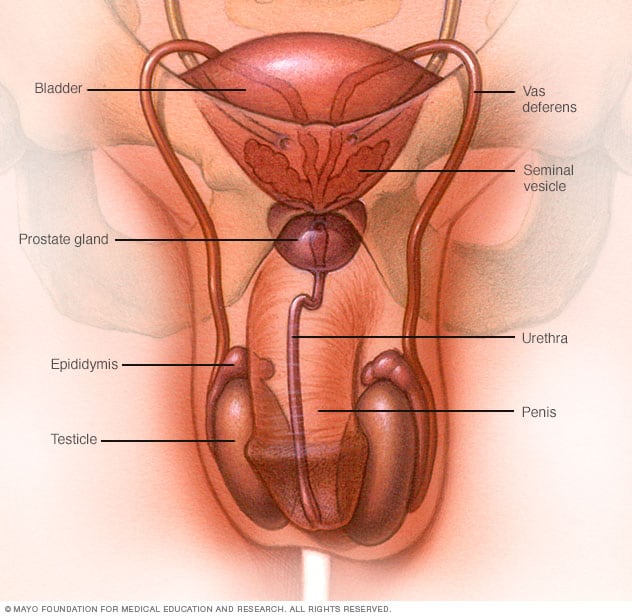
Male reproductive system
The male reproductive system produces, stores and moves sperm. Testicles produce sperm. Fluid from the seminal vesicles and prostate gland combines with sperm to form semen. The penis ejaculates semen during sexual intercourse.
Signs and symptoms of scrotal masses vary depending on the abnormality. Signs and symptoms can include:
-
An unusual lump
-
Sudden pain
-
A dull ache or feeling of heaviness in the scrotum
-
Pain radiating to the groin, abdomen, or lower back
-
Tender, swollen or hardened testicle
-
Tender, swollen or hardened epididymis (ep-ih-DID-uh-miss), the soft, comma-shaped tube above and behind the testicle that stores and transports sperm
-
Swelling in the scrotum
-
Redness of the skin of the scrotum
-
Nausea or vomiting
If the cause of a scrotal mass is infection, signs and symptoms may also include:
- Fieber
-
Urinary frequency
-
Pus or blood in the urine
When to go to the doctor?
Seek emergency medical attention if you develop sudden pain in your scrotum. Some conditions require immediate treatment to avoid permanent damage to a testicle.
See your doctor if you discover a lump in your scrotum, even if it is not painful or tender, or if you notice other symptoms of a scrotal mass.
Some scrotal masses are more common in children. See your doctor if your child experiences symptoms of a scrotal mass, if you have concerns about genital development, or if a testicle is “missing” – an undescended or retractable testicle that may increase the risk of some scrotal masses later in life.
Causes
Spermatocele

Spermatocele
A spermatocele, also known as a sperm cyst, is a typically painless, noncancerous (benign), fluid-filled sac that grows near the tip of a testicle.
Hydrocele

Hydrocele
Hydrocele is the type of scrotal swelling that occurs when fluid builds up in the thin covering that surrounds the testicle.
Varicocele
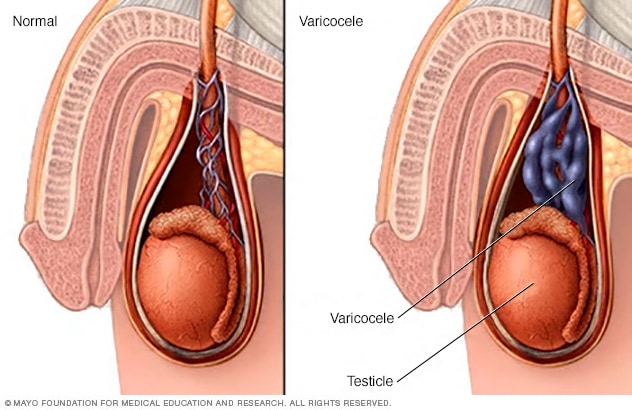
Varicocele
A varicocele is an enlargement of the veins that carry deoxygenated blood away from the testicle.
Inguinal hernia
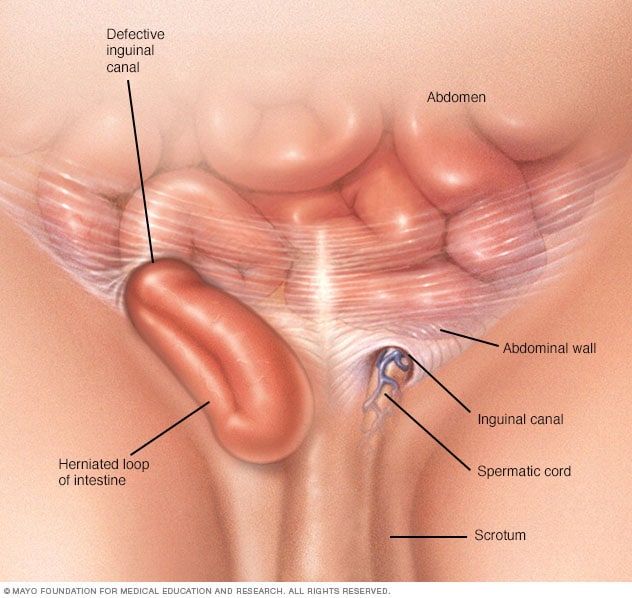
Inguinal hernia
Inguinal hernias occur when part of the membrane lining the abdominal cavity (omentum) or intestines protrudes through a weak spot in the abdomen - often along the inguinal canal, which in men carries the spermatic cord.
A number of medical conditions can lead to a scrotal mass or an abnormality in the scrotum, including:
-
Testicular cancer.Testicular cancer is a tumor that contains abnormal testicular tissue, which can usually be felt as a non-painful lump in the scrotum.
Some men experience pain and swelling, but most tumors cause no symptoms. See your doctor if you notice a new lump in your scrotum.
- Spermatozele. Die Spermatozele, auch bekannt als Spermazyste oder Nebenhodenzyste, ist ein typischerweise schmerzloser, gutartiger (gutartiger), mit Flüssigkeit gefüllter Sack im Hodensack, normalerweise über dem Hoden.
-
Epididymitis.This is an inflammation of the epididymis, the comma-shaped structure above and behind the testicle that stores and transports sperm.
Epididymitis is often caused by a bacterial infection, including sexually transmitted bacterial infections such as chlamydia. Less commonly, epididymitis is caused by a viral infection or abnormal urine flow into the epididymis.
- Orchitis. Dies ist eine Entzündung des Hodens, die normalerweise auf eine Virusinfektion zurückzuführen ist – am häufigsten Mumps. Wenn eine Orchitis durch eine bakterielle Infektion verursacht wird, können auch die Nebenhoden infiziert sein.
-
Hydrocele.Hydrocele occurs when excess fluid is present between the layers of a sac that surrounds each testicle. A small amount of fluid in this space is normal, but the excess fluid from a hydrocele usually causes painless swelling of the scrotum.
In infants, a hydrocele usually occurs because an opening between the abdomen and scrotum was not properly closed during development.
In adults, a hydrocele usually occurs due to an imbalance in the production or absorption of fluid, often as a result of an injury or infection in the scrotum.
- Hämatozele. Eine Hämatozele tritt auf, wenn sich Blut zwischen den Schichten eines Sacks befindet, der jeden Hoden umgibt. Traumatische Verletzungen, wie ein direkter Schlag auf die Hoden, sind die wahrscheinlichste Ursache.
-
Varicocele.This is the expansion of the veins in the scrotum that carry deoxygenated blood from each testicle and the epididymis. Varicocele occurs more often on the left side of the scrotum because blood circulation from both sides is different.
A varicocele can cause infertility.
-
Inguinal hernia.This is a condition in which part of the small intestine pushes through an opening or weak spot in the tissue that separates the abdomen and groin.
In infants, a hernia usually occurs because the passage from the abdomen to the scrotum has not closed during development.
A hernia can occur as a mass in the scrotum or higher in the groin.
-
Testicular torsion.This is a twisting of the spermatic cord, the bundle of blood vessels, nerves and the tube that carries semen from the testicle to the penis.
This painful condition cuts off blood to the testicle and can result in loss of the testicle if not treated promptly. The affected testicle may be lateral, enlarged, and higher than normal.
Risk factors
Factors that increase the risk of a scrotal mass vary due to the various causes of scrotal abnormalities. The main risk factors include:
Raised or retractable testicle
An undescended testicle does not leave the abdomen or enter the scrotum during fetal development or early childhood. A retractable testicle descends into the scrotum but retracts into the abdomen. Both could increase the risk of:
- Leistenbruch
- Hodentorsion
- Hodenkrebs
Abnormalities present at birth
Abnormalities of the testicles, penis, or kidneys that are present at birth (congenital) may increase the risk of a scrotal mass and testicular cancer later in life.
History of testicular cancer
If you have had cancer in one testicle, there is an increased risk of cancer affecting the other testicle. Having a father or brother who has had testicular cancer also increases the risk.
Complications
Not all scrotal masses result in long-term complications. However, any mass that affects the health or function of the testicle can lead to:
- Verzögerte oder schlechte Entwicklung während der Pubertät
- Unfruchtbarkeit
Sources:
- O’Connell T. Hodensackmassen. In: Instant Work-ups: A Clinical Guide to Medicine. 2. Aufl. Philadelphia, Pennsylvania: Elsevier; 2017. http://www.clinicalkey.com. Abgerufen am 26. Februar 2017.
- Fragen Sie MayoExpert. Skrotale Masse (Erwachsener). Mayo-Klinik; 2019.
- Brenner JS, et al. Ursachen von Skrotalschmerzen bei Kindern und Jugendlichen. http://www.uptodate.com/home. Abgerufen am 26. Februar 2017.
- Crawford P. et al. Bewertung von Skrotalmassen. Amerikanischer Hausarzt. 2014;89:723. http://www.aafp.org/afp/2014/0501/p723.html. Abgerufen am 26. Februar 2017.
- Adam A. et al., Hrsg. Männlicher Urogenitaltrakt. In: Diagnostische Radiologie von Grainger & Allison. 6. Aufl. Philadelphia, Pennsylvania: Churchill Livingstone Elsevier; 2015. http://www.clinicalkey.com. Abgerufen am 26. Februar 2017.
- Marx JA, et al., Hrsg. Erkrankungen des Urogenitaltrakts und der Nieren. In: Rosens Notfallmedizin: Konzepte und klinische Praxis. 8. Aufl. Philadelphia, Pennsylvania: Saunders Elsevier; 2014. http://www.clinicalkey.com. Abgerufen am 26. Februar 2017.
- Eyre RC. Bewertung der nicht akuten Skrotalpathologie bei erwachsenen Männern. http://www.uptodate.com/home. Abgerufen am 26. Februar 2017.
- Behandlung von Hodenkrebs. Amerikanische Krebs Gesellschaft. https://www.cancer.org/cancer/testicular-cancer/treating.html. Abgerufen am 26. Februar 2017.
- Habe ich Hodenkrebs? Amerikanische Krebs Gesellschaft. https://www.cancer.org/cancer/testicular-cancer/do-i-have-testicular-cancer.html. Abgerufen am 26. Februar 2017.
- Castle EP (Gutachten). Mayo Clinic, Rochester, Minnesota 7. März 2017.