

 Suche
Suche
 Mein Konto
Ventricular septal defect (VSD)
Ventricular septal defect (VSD)
overview
Ventricular septal defect
Ventricular septal defect
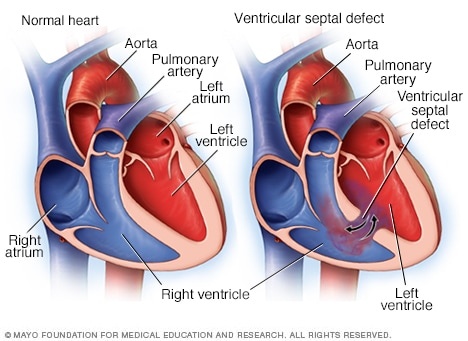
A ventricular septal defect is an abnormal opening (hole) in the heart that forms between the heart's lower pumping chambers (ventricles), as shown in the heart at right. This allows oxygen-rich and oxygen-poor blood to mix. A normal heart is shown on the left.
A ventricular septal defect (VSD), a hole in the heart, is a common heart defect that is present at birth (congenital). The hole (defect) occurs in the wall (septum) that separates the lower chambers (ventricles) of the heart and allows blood to flow from the left to the right side of the heart. The oxygen-rich blood is then pumped back to the lungs instead of the body, making the heart work harder.
A small ventricular septal defect may not cause problems, and many small VSDs close on their own. Medium or larger VSDs may require surgical repair early in life to avoid complications.
Symptoms
Signs and symptoms of serious heart defects often appear in the first days, weeks, or months of a child's life.
Symptoms of a ventricular septal defect (VSD) in a baby may include:
- Schlechtes Essen, Gedeihstörung
- Schnelles Atmen oder Atemnot
- Leicht ermüdend
You and your doctor may not notice any signs of a ventricular septal defect at birth. If the defect is small, symptoms may not appear until later in childhood - if at all. Signs and symptoms vary depending on the size of the hole and other associated heart defects.
Your doctor may first suspect a heart defect during a regular exam if he or she hears a heart murmur while listening to your baby's heart with a stethoscope. Sometimes a VSD can be detected by ultrasound before the baby is born.
Sometimes a VSD is not recognized until a person reaches adulthood. Symptoms and signs may include shortness of breath or a heart murmur, which your doctor hears when listening to your heart with a stethoscope.
When to go to the doctor?
Call your doctor if your baby or child:
- Ermüdet leicht beim Essen oder Spielen
- Nimmt nicht zu
- Atemlos beim Essen oder Weinen
- Atmet schnell oder ist kurzatmig
Call your doctor if you develop:
- Kurzatmigkeit, wenn Sie sich anstrengen oder wenn Sie sich hinlegen
- Schneller oder unregelmäßiger Herzschlag
- Müdigkeit oder Schwäche
Causes
Congenital heart defects arise from problems in the early development of the heart, but there is often no clear cause. Genetics and environmental factors can play a role. VSDs can occur alone or together with other congenital heart defects.
During fetal development, a ventricular septal defect occurs when the muscular wall that separates the heart into left and right sides (septum) does not fully form between the lower chambers of the heart (ventricles).
Normally, the right side of the heart pumps blood to the lungs for oxygen; the left side pumps the oxygen-rich blood to the rest of the body. A VSD allows oxygen-rich blood to mix with oxygen-poor blood, resulting in increased blood pressure and increased blood flow in the pulmonary arteries. This leads to increased work for the heart and lungs.
VSDs can be of various sizes and present in multiple locations in the wall between the ventricles. There can be one or more VSD.
It is also possible to acquire a VSD later in life, usually after a heart attack or as a complication after certain heart surgeries.
Risk factors
Ventricular septal defects can run in families and sometimes occur with other genetic problems such as Down syndrome. If you already have a child with a heart defect, a genetic counselor can discuss the risk of your next child having one.
Complications
A small ventricular septal defect can never cause problems. Medium or large defects can cause a range of disabilities, from mild to life-threatening. Treatment can prevent many complications.
Complications can be:
- Herzfehler. In einem Herzen mit einem mittleren oder großen VSD arbeitet das Herz härter und die Lunge wird zu viel Blut zu sich gepumpt. Ohne Behandlung kann sich eine Herzinsuffizienz entwickeln.
- Pulmonale Hypertonie. Erhöhter Blutfluss zur Lunge aufgrund des VSD verursacht Bluthochdruck in den Lungenarterien (pulmonale Hypertonie), der diese dauerhaft schädigen kann. Diese Komplikation kann zu einer Umkehrung des Blutflusses durch das Loch führen (Eisenmenger-Syndrom).
- Endokarditis. Diese Herzinfektion ist eine seltene Komplikation.
- Andere Herzprobleme. Dazu gehören Herzrhythmusstörungen und Herzklappenprobleme.
prevention
In most cases, there is nothing you can do to prevent a baby from being born with a ventricular septal defect. However, it is important to do everything you can to have a healthy pregnancy. Here are the basics:
- Holen Sie sich frühzeitig Schwangerschaftsvorsorge, noch bevor Sie schwanger sind. Sprechen Sie mit Ihrem Arzt, bevor Sie schwanger werden, über Ihre Gesundheit und besprechen Sie alle Änderungen des Lebensstils, die Ihr Arzt für eine gesunde Schwangerschaft empfehlen könnte. Stellen Sie außerdem sicher, dass Sie mit Ihrem Arzt über alle Medikamente sprechen, die Sie einnehmen.
- Sich ausgewogen ernähren. Fügen Sie ein Vitaminpräparat hinzu, das Folsäure enthält.
- Regelmäßig Sport treiben. Arbeiten Sie mit Ihrem Arzt zusammen, um einen Trainingsplan zu entwickeln, der für Sie richtig ist.
- Vermeiden Sie Risiken. Dazu gehören Schadstoffe wie Alkohol, Tabak und illegale Drogen.
- Vermeiden Sie Infektionen. Stellen Sie sicher, dass Sie alle Ihre Impfungen auf dem neuesten Stand haben, bevor Sie schwanger werden. Bestimmte Arten von Infektionen können für einen sich entwickelnden Fötus schädlich sein.
- Diabetes unter Kontrolle halten. Wenn Sie Diabetes haben, arbeiten Sie mit Ihrem Arzt zusammen, um sicherzustellen, dass er gut eingestellt ist, bevor Sie schwanger werden.
If you have a family history of heart defects or other genetic disorders, you should speak to a genetic counselor before becoming pregnant.
Sources:
- Angeborene Herzfehler. Nationales Institut für Herz, Lunge und Blut. https://www.nhlbi.nih.gov/health-topics/congenital-heart-defects. Abgerufen am 20. Januar 2021.
- Ventrikelseptumdefekt (VSD). American Heart Association. https://www.heart.org/en/health-topics/congenital-heart-defects/about-congenital-heart-defects/ventricular-septal-defect-vsd#. Abgerufen am 20. Januar 2021.
- Fulton DR, et al. Isolierte Ventrikelseptumdefekte bei Säuglingen und Kindern: Anatomie, klinische Merkmale und Diagnose. https://www.uptodate.com/contents/search. Abgerufen am 20. Januar 2021.
- Zipes DP, Hrsg. Angeborene Herzfehler bei erwachsenen und pädiatrischen Patienten. In: Herzkrankheit Braunwald: Ein Lehrbuch der Herz-Kreislauf-Medizin. 11. Aufl. Elsevier; 2019. https://www.clinicalkey.com. Abgerufen am 20. Januar 2021.
- Connolly HM, et al. Management und Prognose des Ventrikelseptumdefekts bei Erwachsenen. https://www.uptodate.com/contents/search. Abgerufen am 20. Januar 2021.
- Fragen Sie MayoExpert. Ventrikelseptumdefekt. Mayo-Klinik; 2020.
- Fulton DR, et al. Management von isolierten Ventrikelseptumdefekten bei Säuglingen und Kindern. https://www.uptodate.com/contents/search. Abgerufen am 21. Januar 2021.