

 Suche
Suche
 Mein Konto


A highly effective new vaccine to protect against shingles will soon be made available to over-70s in the UK.
The jab, Shingrix, is widely available in the US and is far more successful at preventing the painful viral skin condition than the vaccine currently offered on the NHS.
Studies have shown that Shingrix can reduce the risk of shingles by more than 90 percent, compared to 50 percent for Zostavax, which is currently offered to all Brits over 70.
The Shingrix vaccination is currently only being given to a limited number of NHS patients, but the health service is expected to start offering it to many more this year.
It is believed the vaccine could be administered to patients as young as 55 by 2024.
“This is a watershed moment,” says Professor Adam Finn, a member of the Joint Committee on Vaccination and Immunization.
"The moment the US authorities saw the Shingrix data they dropped Zostavax like a hot potato, and the same thing will happen in the UK. We will be phasing out Zostavax rapidly over the next two to three years."
The news will come as a relief to the millions of Britons at risk of developing lifelong chronic pain caused by shingles. More than 50,000 get it every year, and almost one in four develop it at some point in their lives.

Last October, presenter Eamonn Holmes revealed he had shingles in 2018. He was forced to take time off from ITV's This Morning due to a rash that covered his face and caused severe stabbing pain. Pictured: Holmes with Ruth Langsford on This Morning
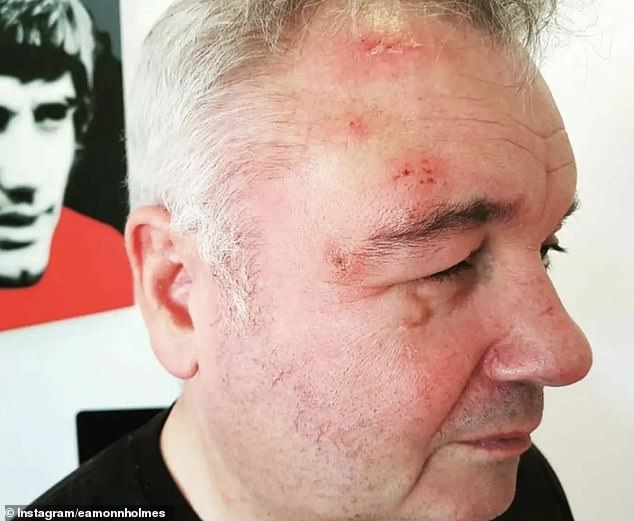
Holmes said doctors were "really concerned" when they saw the rash had spread to his eyelids (above), as the condition can cause blindness
Shingles is linked to chickenpox, the highly contagious disease that causes itchy, blotchy rashes.
When caught at a young age, chickenpox is usually not serious, but the virus that causes it, varicella zoster, remains in the body for life and hides in the spinal nerves.
It is kept in check by the immune system, but this weakens with age, allowing the virus to potentially reactivate and attack the body again.
People with shingles develop a blotchy, red rash that forms blisters. It usually appears on one side of the chest or abdomen, but can be anywhere on the body.
Often accompanied by headaches and nausea, the rash can be extremely painful and last for several weeks.
Last October, presenter Eamonn Holmes revealed he had shingles in 2018.
He was forced to take time off from ITV's This Morning due to a rash that covered his face and caused severe stabbing pain.
He said doctors were "really concerned" when they saw the rash had spread to his eyelids as the condition could cause blindness.
In a fifth of patients, shingles can also trigger postherpetic neuralgia, a nerve pain condition that can last for months and for which there is no treatment.
“The pain is practically always there,” says Dr. Michael Serpell, pain expert at Stobhill Ambulatory Care Hospital in Glasgow.
“Even a cold breeze can trigger excruciating nerve pain in the face or chest.”
![Die Shingrix-Impfung wird derzeit nur einer begrenzten Anzahl von NHS-Patienten verabreicht, aber der Gesundheitsdienst wird voraussichtlich dieses Jahr damit beginnen, sie vielen weiteren anzubieten. Es wird angenommen, dass der Impfstoff bis 2024 Patienten im Alter von nur 55 Jahren verabreicht werden könnte. [File image]](https://redaktion.institut-der-gesundheit.com/wp-content/uploads/2024/05/1645516045_116_Ein-%E2%80%9Ebahnbrechender-Impfstoff-der-das-Risiko-einer-Guertelrose-um-mehr.jpg)
The Shingrix vaccination is currently only being given to a limited number of NHS patients, but the health service is expected to start offering it to many more this year. It is believed the vaccine could be administered to patients as young as 55 by 2024. [File image]
Shingles can even be fatal, with around 50 deaths in the UK every year.
Britons over 70 have been offered a shingles vaccination on the NHS and Zostavax has been used since 2013.
“It was very helpful, but it is far from the ideal jab,” says Prof Finn.
"As we get older, Zostavax becomes less effective. That's a problem because that's exactly the age group we're trying to protect."
Shingrix, developed by British pharmaceutical company GlaxoSmithKline, was shown in studies published in 2020 to reduce the risk of both shingles and post-herpetic neuralgia by more than 90 percent.
Crucially, studies show the vaccine, given in two doses, provides strong protection for people as young as 90.
The jab has been licensed for use since 2018, but high demand in America meant it was largely unavailable in the UK, making it pointless to recommend it for NHS use.
It is only offered to NHS patients with weakened immune systems, where Zostavax can cause serious side effects.
Now experts say extra supplies mean a decision on whether to use Shingrix instead of Zostavax is imminent. Prof Finn, from the Joint Committee on Vaccination and Immunization, said: “I expect we will make a decision on this in the coming months.”
The news is welcomed by Joanne Mills, 56, from West Yorkshire, who has suffered from post-herpetic neuralgia for more than 20 years after developing shingles in her 30s.
The psychiatrist says the painful, itchy rash returns at least every two months and can last ten days.
“I have it on my thigh and it makes wearing even loose-fitting clothes terrible because they rub against the rash,” says the mother of three. “On a scale of one to ten, I would say the pain is an 11 at worst.”
Doctors believe a shingles vaccine would help reduce Joanne's flare-ups, boost her immunity to the virus and keep it at bay.
“Any vaccine I could get sooner that would help ease the pain I've lived with for decades would be incredible,” she says.