

 Suche
Suche
 Mein Konto


After actress Sienna Miller revealed she froze her eggs when she was 40, it has emerged that British women continue to do so until their 50th birthday.
The Human Fertilization and Embryology Authority (HFEA) says egg freezing should not be recommended for women in their 40s.
The likelihood of becoming pregnant with her eggs is “very low,” it is said.
But this hasn't stopped fertility clinics from allowing women to follow in the footsteps of Miss Miller, who revealed this month that she had her eggs frozen when she was 40 to avoid the "existential threat" to her ticking biological clock.

After actress Sienna Miller revealed she froze her eggs when she was 40, it has emerged that British women continue to do so until their 50th birthday
Latest figures show women aged 45 to 50 had a record number of cycles to freeze their eggs in 2019. The total number of 23 cycles in the UK was up from 20 the previous year, from just 10 in 2016 and fewer than five in 2014.
An age breakdown provided by the HFEA shows that at least one woman aged 49 had her eggs frozen in 2015.
Some of the cycles may have been performed for medical reasons and not just for “social” reasons – when women have not yet found the right partner or are not yet ready to start a family.
But experts fear that the trendy egg freezing trend is being offered to women who are too old to benefit from it.
Joyce Harper, professor of reproductive science at University College London, said: "I think freezing eggs over 35 is problematic as there is less chance of pregnancy. At 49 it is completely pointless as these eggs will not result in pregnancy.
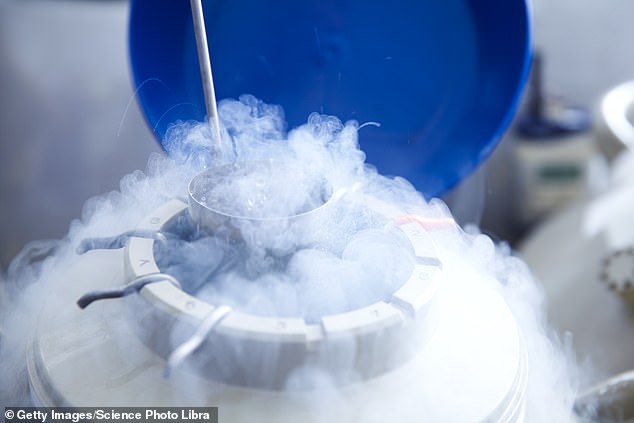
Latest figures show women aged 45 to 50 had a record number of cycles to freeze their eggs in 2019
"It is likely that egg freezing will have about the same success rates as IVF, which is highly age-dependent. The UK data for IVF shows that the chance of becoming pregnant over 40 is very low - 11 per cent for those aged 40 to 42 and 5 per cent for those aged 43 to 44."
When women freeze their eggs when they are younger, it provides a better chance of having a baby. This is because the eggs are of better quality and therefore more likely to result in pregnancy when women use them for IVF later in life. But frozen eggs from women over 40 tend to be of poorer quality and therefore may not provide the same benefit.
This raises the question of whether the cost of the procedure, which can average £8,000 for egg freezing and thawing, is worth it for this age group.
Sarah Norcross, from fertility charity Progress Educational Trust, said: "Women aged 40 and over who are considering freezing their eggs need good quality, independent information about their reduced chances of success in the future. Clinic marketing materials can give an unrealistically optimistic impression.
“Any woman freezing her eggs at this age… should be aware that her chances of success are lower.” The fertility industry has been criticized for its marketing of egg freezing, with clinics inviting women to wine and cheese nights to discuss it or offering them prosecco.
The most common age at which women freeze their eggs is 38. However, doctors say the best time is in their 20s and 30s. Miss Miller, 40, has a nine-year-old daughter named Marlowe with actor Tom Sturridge, who she dated from 2011 to 2015.
In an interview with Elle magazine, Miss Miller said: "[I felt] pressure [about] children, and should I have more, and why haven't I, and all that, which is a really loud noise. Biology is incredibly cruel to women this decade - that's the headline, or at least it was for me. Then I got to 40 and froze a few eggs.
“Because I’ve been really focused on the need to have another baby, I just think, ‘If it happens, it happens.’ That kind of existential threat has dissipated.”
Clare Ettinghausen from the HFEA said: "The decision to freeze your eggs is a serious undertaking and, as well as the cost, involves a degree of risk. Freezing your eggs is not a guarantee that you will have a baby in the future, but the younger you freeze your eggs, the greater the chances of success."