

 Suche
Suche
 Mein Konto


A 13-week-old baby's life was saved by a groundbreaking operation that replaced a tiny valve in her walnut-sized heart with a metal frame and tissue from a cow.
Florence Fox, from Sidcup, south-east London, was diagnosed at just nine weeks old with a rare disease that affects one of the valves that ensure oxygen-rich blood flows properly. Young children with the condition, known as mixed mitral valve disease, face high mortality rates if left untreated.
Doctors at Evelina London Children's Hospital had told Florence's parents, Jenny, 33, and Billy, 38, a construction manager, that they would wait until she was older and stronger before operating - but when her health rapidly deteriorated they were forced to act.
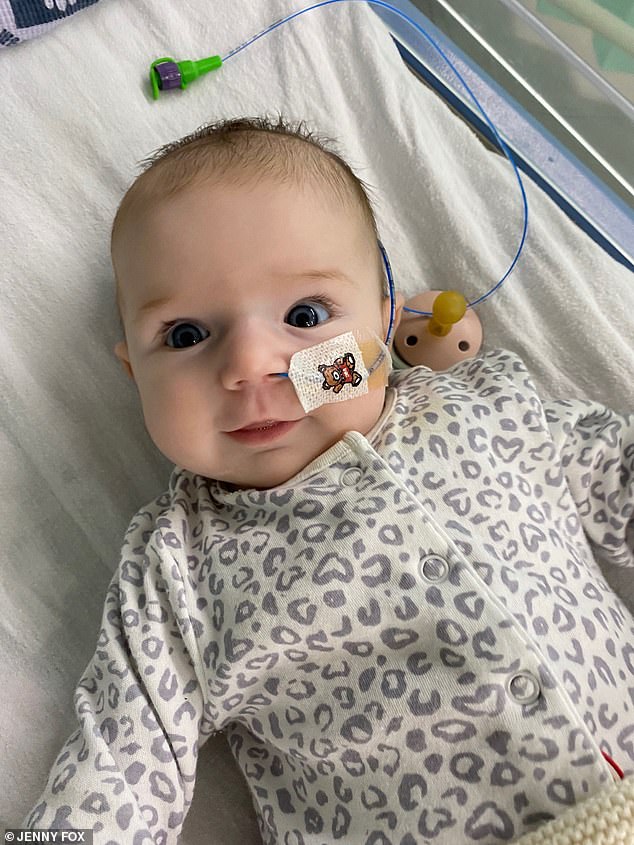
Florence Fox, from Sidcup, south-east London, was diagnosed at just nine weeks old with a rare disease that affects one of the valves that ensure oxygen-rich blood flows properly

The mitral valve is a valve that helps the heart pump oxygen-rich blood from the lungs throughout the body. If it is defective - and does not close tightly - blood can leak backwards and seriously damage the heart. In the UK, the condition results in around 70 children undergoing surgery each year
“She looked terrible – she was gray and couldn’t keep anything down,” says Jenny, who works in finance at the London Metal Exchange. “The doctors said they had to operate or she wouldn’t leave the hospital.”
The mitral valve is a valve that helps the heart pump oxygen-rich blood from the lungs throughout the body. If it is defective - and does not close tightly - blood can leak backwards and seriously damage the heart. In the UK, the condition results in around 70 children undergoing surgery each year.
In older children and adults, surgeons typically try to repair the fragile heart valve, which is located on the left side of the heart. If this is not possible, it can be replaced with a metal valve, but these are too large for very young children, and the operation has a high death rate and serious complications, including stroke.
Recently, surgeons have turned to the Melody valve, a cow heart valve that sits on a metal frame and is usually used in a different area of the heart and in larger children and adults. Crucially, the frame size can be changed to fit the patient's heart.
According to Dr. Aaron Bell, a pediatric cardiologist, said the procedure was developed over the past two years because previous options were not suitable for young children. He added: "Without this operation, Florence's outlook was bleak. The valves typically used for this procedure are too large and have a high complication rate. This approach is new - something she would not have had a few years ago."
Open-heart surgery is increasingly being offered to infants who would die without it - some as young as a few days old. Nine patients have undergone the new valve procedure at Evelina, and Florence was the smallest so far at less than 10 pounds and the youngest at 13 weeks.
The success of the operation at the hospital will soon be presented in a paper at the annual conference of the Society for Cardiothoracic Surgery in Great Britain and Ireland.
“Only about 50 percent of young children survive a mechanical valve, so we do everything we can to avoid it,” says Conal Austin, Evelina’s consultant pediatric heart surgeon. “With this approach, children recover quickly.”
During the six-hour procedure last September, Florence was connected to a heart-lung bypass machine that pumped oxygen into her blood and around her body while her walnut-sized heart was stopped.
Valve replacements are often performed through an incision in the leg - the new valve is threaded up and into the heart through a tube called a catheter. But this is not possible with babies because the heart is simply too small. Florence had her heart cut open and the defective valve removed. The newly adapted Melody valve was placed on a catheter with a thin balloon and maneuvered into place. The balloon was then inflated to expand the valve and ensure a tight fit. Both the balloon and catheter were then removed and the new valve was sewn into place. Florence's heart was then closed and restarted.
Jenny says: "Signing the consent form before the operation was terrible - it listed all the risks, including the fact that she could die or have brain damage. But we knew it was her only chance of getting out of hospital. She had surgery around midday and was back in intensive care by 6pm.
"She was sedated and covered in so many tubes that it was hard to even see her. But a few days later she was back in the ward and smiling. She still seemed weak, but you could already see the color in her cheeks and I could see she was getting better."
Jenny always felt like there was something wrong with her daughter, even though her GP had told her she had just had reflux - a common condition caused by excess stomach acid where the baby produces milk and is unable to calm down.
She says: "When Florence was born she made a strange squeaking, grunting noise with every breath. At first I thought it was cute, but as time went on it started to worry me. She always seemed uncomfortable and didn't like being held, she just wanted to lie flat."
At nine weeks, Florence abruptly stopped eating. Jenny and Billy took her to their local hospital. Staff discovered she had a heart problem and she was taken by ambulance to Evelina - part of Guy's and St Thomas NHS Foundation Trust - where specialists diagnosed mixed mitral valve disease.
Florence's heart gave out, her lungs filled with fluid and she struggled to breathe.
“They told us she had to choose between breathing and eating and so she stopped drinking milk,” says Jenny, who also has a four-year-old daughter called Ava. After the operation, Florence recovered quickly - she was able to go home just eight days later.
“She’s a very happy, lively baby now,” says Jenny. "She's always chattering away and hitting all her milestones. She's eating normally. It's so nice."
Florence will still need to undergo surgery in the future as the valve will need to be replaced as it grows.
Dr. Bell says the development of the technique that saved Florence needs more research to see how well it works, but that it's off to a promising start. "Her heart is working much better. We are very happy with how she is doing," he says. “This approach has given us new options for our young patients who desperately need it.”